Event takeaways
Indoor Ag Science Cafe #86: CEA Stats and Trends
By Noah Langenfeld, United Greenhouse Growers Association
The event
The 86th Indoor Ag Science Cafe was held a few days ago on October 20, 2026. Originally developed by Dr. Cheiri Kubota at the Ohio State University, this webinar was hosted in conjunction with OptimIA, CEA Herb, ADVANCEA, and the United Greenhouse Growers Association.
The discussion focused on some of the main takeaways from the recent USDA Census of Horticultural Specialties. The data, while collected in 2024, was only released earlier this year. Despite the wealth of information included in the report, the only way to find the data is by looking through the hundreds of pages of tables provided by the USDA.
I decided to take an alternative, yet cumbersome, approach to start to visualize some of the trends specifically related to greenhouse production and indoor agriculture.
Highlights
The US had just over 20,000 acres of greenhouse production in 2024.
74% of the greenhouse area in the US is covered by plastic film.
About 2,000 (10%) of all greenhouse acres are dedicated to food production. The rest are mainly used by flower and nursery operations.
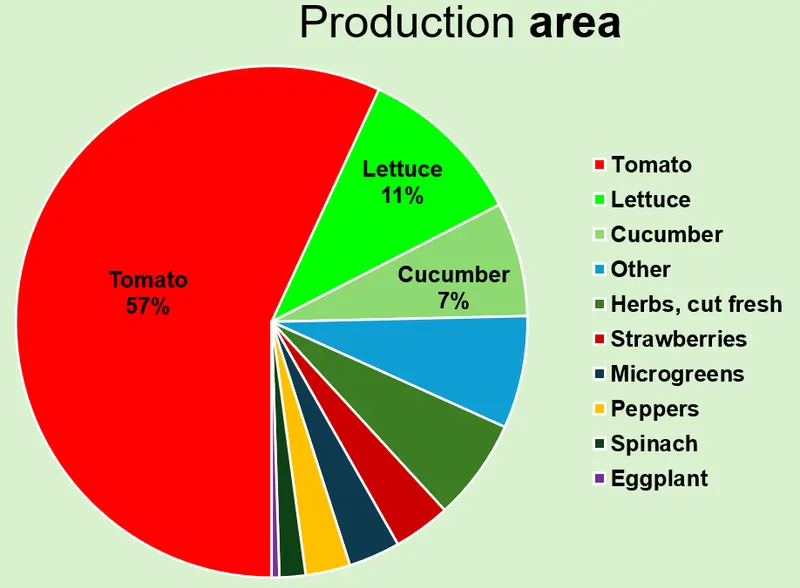
Tomatoes account for 57% of the production area of greenhouse crops in the US.
Microgreens were reported to be the most productive on a $ per square foot basis.
The full USDA Census of Horticultural Specialties report can be found at this link.
Takeaways
The presence of redacted data in the census makes it difficult to draw firm conclusions of the presented results. Data is removed if it could be used to determine the characteristics of a individual operator, but this complicates overall interpretation. Additional work will be needed to determine the contribution of the largest operations in each state to the total picture.
Greenhouse food production is growing, but it is unbalanced across the country. Maine and Vermont have the highest amount of greenhouse acreage in relation to their population, while Utah and Wyoming have the least. We must ask where effort and investment is needed to improve production quality and quantity across the country.
Recording
The webinar was recorded and is available for free on YouTube!